What a song can do to the inevitable
Hadestown, the power of music and Theatre’s extraordinary ability to make us believe in what we already know to be impossible.
Theatre, Music and AudiencesAndré Marques Moreira14 min read
Published 19 October 2026Updated 24 October 2026
One flower, two moments
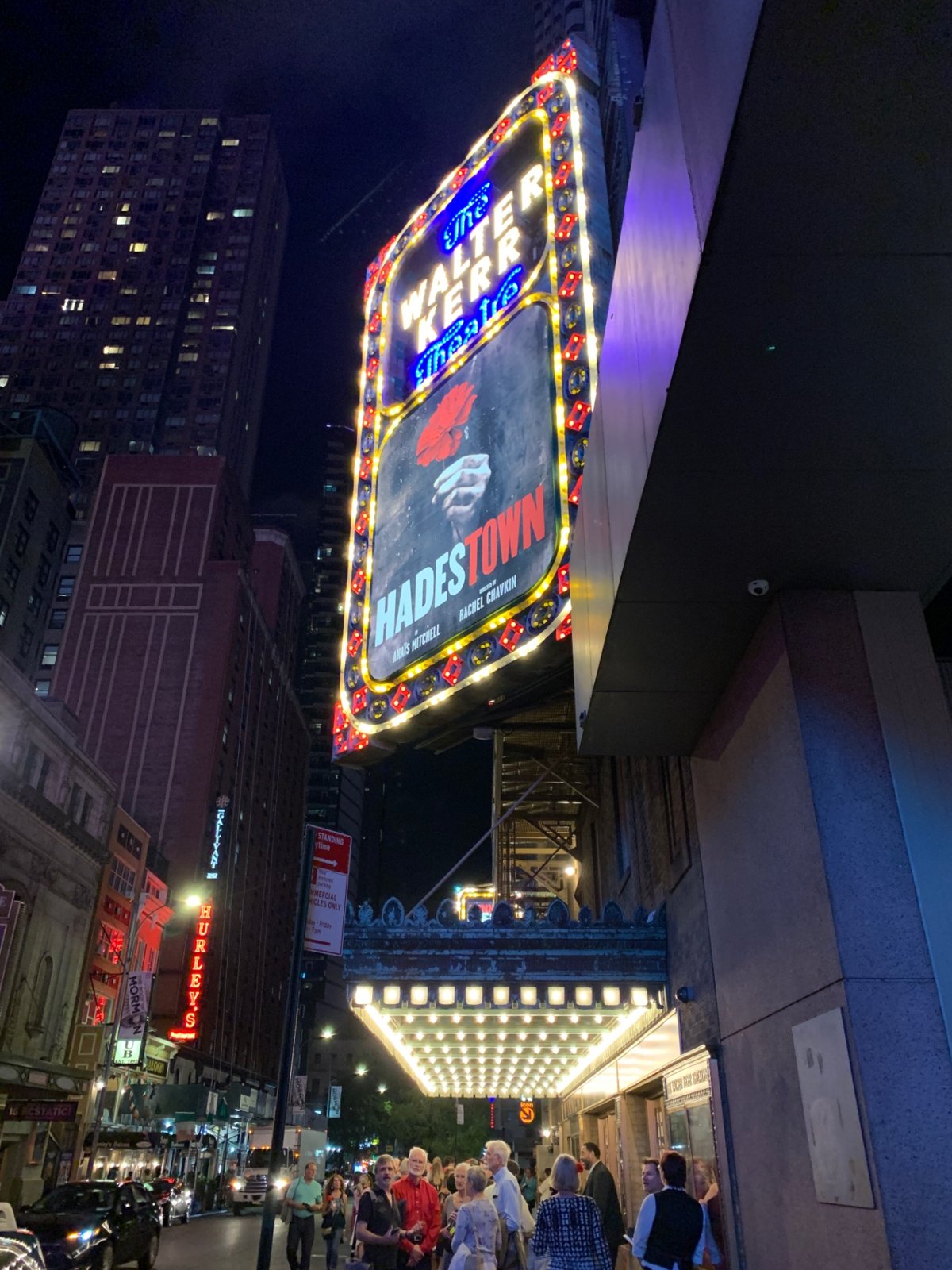
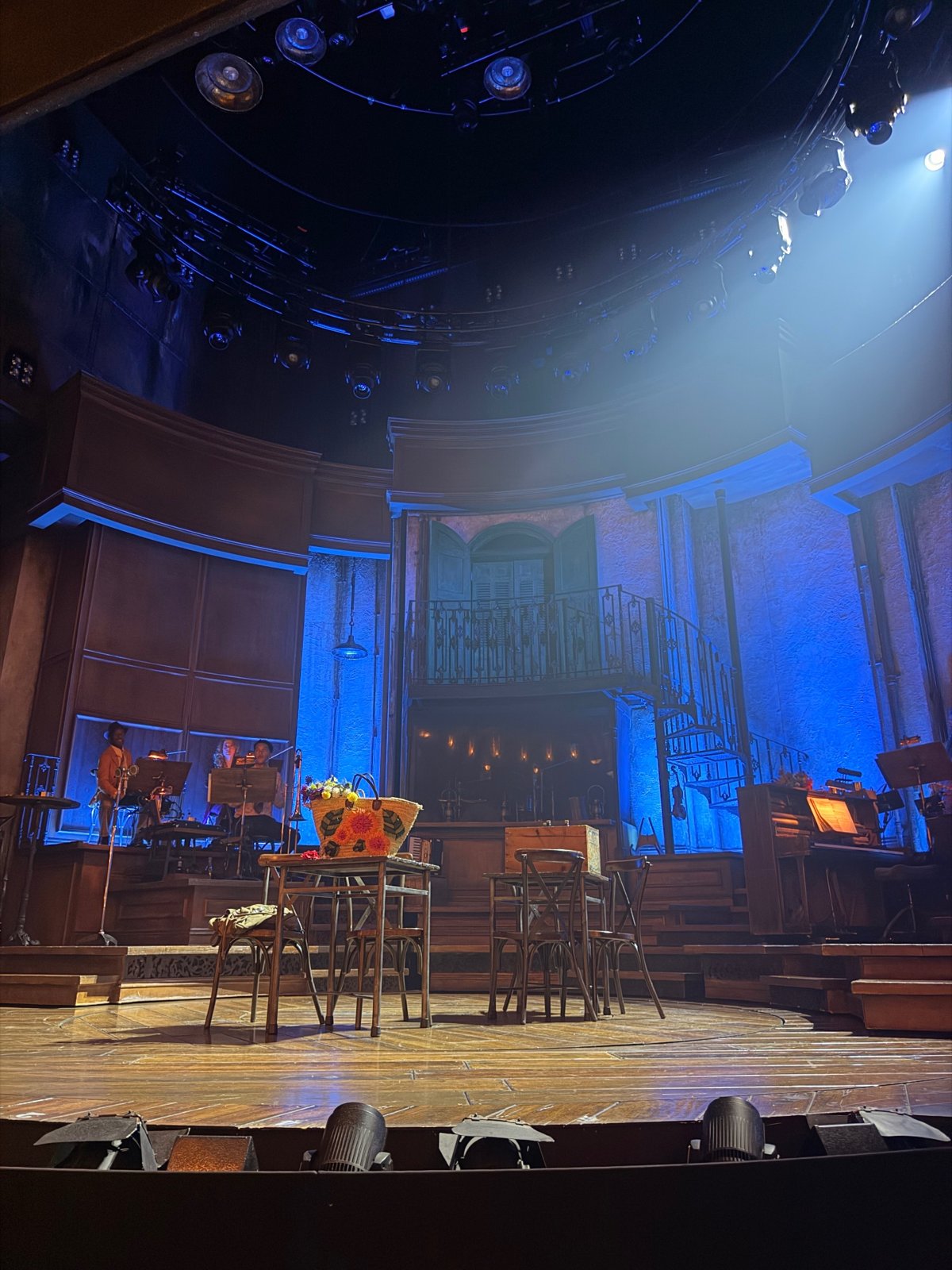
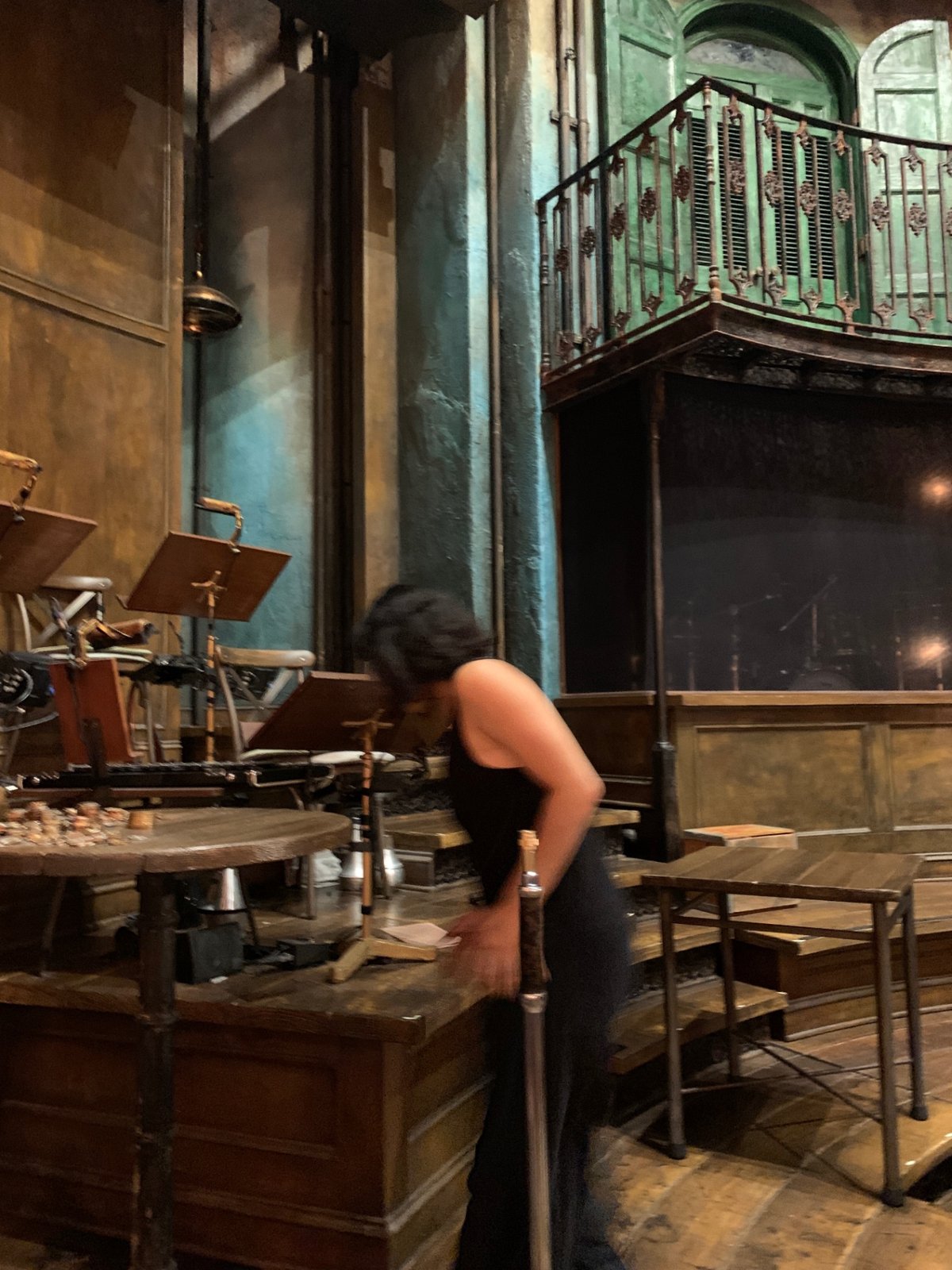
There is a red flower I have kept since 2019. It was given to me on the stage of Hadestown at the Walter Kerr Theatre in New York, during a visit made possible by my friend Justin, which I still remember today. I entered through the stage door, walked through the backstage areas and stepped onto the very stage where the original Broadway cast performed. I remember the wooden structures, the weathered green doors, the spiral staircase and the instruments arranged in a space that seemed to exist somewhere between a tavern, a factory and a place that had never truly existed. I had the opportunity to exchange a few words with Eva Noblezada, who played Eurydice, although the only photograph I managed to keep of that encounter shows nothing more than her blurred silhouette crossing the stage. At the time, what interested me most was the extraordinary opportunity to see a production of that scale from the inside, to observe its workings and to be close to the people who made it possible. I could not have imagined that, seven years later, I would return to that story with a different kind of curiosity, this time sitting in the audience of a Theatre in London.

The relationship we develop with a work does not always begin when we first discover it. Sometimes we need to return to it, accumulate other experiences or simply learn to look differently. For a long time, I did not fully understand the enthusiasm surrounding Hadestown, or why this contemporary interpretation of the myth of Orpheus and Eurydice had secured such a distinctive place in Musical Theatre. Watching the London production, I began to recognise the intelligence of a show that does not seek to impress through an accumulation of resources, but through the precision with which it uses them. There is an unusual coherence between what it seeks to tell and the way every element contributes to that construction, without the sophistication of its theatrical language becoming a demonstration of its own complexity.
The precision of a world
The set presents a world of worn materials, industrial structures and references to an undefined past, where the presence of the musicians, the movement of the characters and the very architecture of the space contribute to a constant sense of motion. Everything seems to have a purpose, even what apparently remains still, and there is a particular pleasure in discovering how the same place can be transformed through subtle changes in light, sound or the positioning of the performers. The stage does not attempt to reproduce faithfully the world it represents; instead, it offers the spectator the elements needed for their imagination to complete what is missing. It is a form of trust in the audience that I find particularly interesting, because it does not assume that everything needs to be explained or made tangible to acquire meaning. The set establishes the rules of that universe and, from that moment onwards, a change of atmosphere is enough for us to understand that we have crossed a boundary.
That attention to the spectator’s experience becomes particularly evident in the relationship between sound design and the acoustics of the auditorium. Throughout the performance, there seems to be a carefully constructed balance between the amplified presence of the voices and the sense of closeness we associate with the natural sound of Theatre. There are moments when a voice seems to acquire an almost confidential intimacy, while at others we recover the physical dimension of a performer singing before an audience, accompanied by musicians whose presence is part of the show’s very identity. This oscillation contributes to the dramatic intensity and made me think about how technological developments have changed our relationship with live performance. Today, we have the means to control with immense precision what an audience hears, but that possibility also carries the risk of standardising an experience whose singularity lies precisely in human presence. In Hadestown, I found a particularly stimulating pursuit of that balance, as though technique were constantly serving to preserve a certain purity of sensation.
The same is true of the lighting, which does not merely establish atmospheres or signal changes of location, but actively shapes the way we follow the narrative. A face can emerge from the shadows, a character can acquire an unexpected presence, or a small area of the stage can concentrate all our attention while the rest of the space remains available to be discovered. Light guides the eye without closing the experience down too tightly, allowing the spectator to participate in constructing what they see. This relationship between guidance and freedom seems particularly well resolved, especially in a show with so many elements capable of competing for our attention. Sophistication reveals itself, after all, less in the number of things happening simultaneously than in the intelligence with which we are led through them.
It is here that the presence of Hermes becomes fundamentally important. As the figure who introduces the characters, accompanies events and establishes direct communication with the audience, Hermes acts as a kind of narrative consciousness, constantly reminding us that we are witnessing a story someone has chosen to tell again. This intervention allows the action to progress with remarkable clarity, even as the music, set and movement construct different layers of meaning. This is not simply a character who explains what happens, but someone who establishes the rhythm of our listening, brings distant events closer and invites us to participate in a kind of collective ritual. We know we are watching a performance and yet accept its rules entirely. Far from diminishing the emotion, this awareness of artifice ultimately strengthens our willingness to believe.
The song and power
But it would be reductive to understand Hadestown merely as an extraordinary aesthetic construction around a love story. The work has a political dimension deeply integrated into its dramaturgy, transforming the classical myth into a reflection on labour, inequality, fear and the mechanisms through which power seeks to ensure its own continuity. The underworld ruled by Hades is presented as an organisation where security comes at a price and the promise of protection ultimately justifies the loss of freedom. The workers build a wall, obey an apparently unquestionable order and help maintain a system that offers them precisely what it takes away: the illusion that there is no other way to live. What is most disturbing is not simply the existence of that structure, but the way it manages to become acceptable to those who remain within it. When fear runs deep enough, submission can begin to be mistaken for survival.
It is in this context that Orpheus’s music acquires a force extending far beyond the individual expression of his feelings. Orpheus has no authority, wealth or any of the instruments through which Hades exercises his dominion. His only possibility of intervention lies in what he can sing and, above all, in his ability to make others listen. When his voice draws the workers’ attention, what seemed to be merely an attempt to recover Eurydice begins to disturb the organisation of an entire world. The song introduces doubt where there was once obedience, allowing those accustomed to repeating the same certainties to begin imagining that reality could be different. There is a profoundly political dimension to this gesture, because Hades’s power depends not solely on his authority, but also on his ability to define the limits of what others consider possible.
It is interesting to realise that music does not function here as a miraculous solution to the conflicts the story presents. Orpheus has no political programme, nor does his song resolve the contradictions of a society built upon labour and inequality. What he can do is alter the characters’ relationship with what they believed inevitable. Through music, he awakens in the workers an awareness that repetition and fear had numbed and, at the same time, forces Hades himself to confront the memory of a feeling that the exercise of power seemed to have driven away. The conflict no longer takes place only between those who govern and those who obey, but also within the characters themselves, between who they are and who they once imagined they might become. The song does not eliminate the structures of power, but reveals that those structures depend on human beings who can still be moved, challenged or transformed.
The song does not eliminate the structures of power, but reveals that those structures depend on human beings who can still be moved, challenged or transformed.
This is, for me, one of Hadestown’s most stimulating ideas: the possibility of Art intervening in the way a community understands its own condition. Not because a work necessarily has to defend a political position or offer solutions to society’s problems, but because it can question the discourses through which we learn to accept certain realities. Human organisations are not sustained solely by material, economic or institutional structures. They are also sustained by the stories they tell about themselves, the convictions they transmit and the repetition of ideas that, over time, cease to seem like choices and come to be understood as truths. When a song manages to interrupt that repetition, even if only for a moment, it introduces the possibility of another narrative. And perhaps one of the deepest expressions of freedom is precisely the ability to recognise that what was presented to us as inevitable may, after all, be the result of human decisions.
The choice of an ancient myth to develop this reflection makes the result more interesting still. The story of Orpheus and Eurydice has travelled through centuries, been revisited by different artists and adapted to languages that seem to have little in common, without losing its ability to find new meanings. The classics retain their force not because they remain protected from all transformation, but because they withstand it and, in many cases, become even more revealing when confronted with the present. Hadestown does not simply seek to update an old narrative through a contemporary aesthetic; it discovers within it conflicts that continue to organise human experience and finds a language capable of bringing them close to a society surrounded by other forms of power, dependence and inequality. The past thus becomes an instrument for observing the present, demonstrating that a story’s relevance depends not on the period in which it was written, but on the questions it can still provoke.
Knowing the ending, still believing
There is, however, a particularly fascinating contradiction in the very experience of watching Hadestown. We know the myth, we know that the story of Orpheus and Eurydice does not reach the resolution we desire, and yet we follow their journey hoping that something might happen differently. It is one of Theatre’s most extraordinary privileges: allowing our emotional relationship with a narrative to contradict what we rationally know about it. During the performance, knowing the ending does not destroy the possibility of hope; instead, it seems to intensify it, because we are invited to participate in an event whose outcome does not depend on us and before which we nevertheless continue to wish for another possibility. The show itself makes this contradiction an essential part of its identity, as though recognising that there are stories we return to not to discover what happens, but to experience again what it means to believe.
That experience will never be exactly the same for everyone. Each spectator enters the auditorium accompanied by their references, tastes, lived experiences and whatever willingness they possess at that moment to become involved. What interests me is understanding how such a rigorously constructed show can bring distinct sensibilities together within a shared experience, without requiring them all to reach the same interpretation. The community formed during a performance does not need to agree about what it saw to recognise that it participated in a common event. For a few hours, people who will probably never meet again share the attention, silence, expectation and breath of a space where a story comes into existence before their eyes. At a time when much of our cultural experience is fragmented, individualised and mediated by devices, this collective willingness to listen seems to acquire a special significance.
What we take with us
Throughout my work in cultural communication, I have sought to understand how a relationship is built between a work and the audience we wish to reach. The need to make a show visible, communicate its identity and awaken the interest of those who do not yet know it naturally occupies an important part of that work. But watching Hadestown reminded me of a distinction I consider essential: we can create the conditions for someone to enter a Theatre, but we cannot determine what that person will take with them when they leave. There is a moment when communication completes its role and the work truly begins to establish a relationship that no longer belongs to us. And it would be a mistake to confuse a campaign’s success with the totality of a show’s cultural impact, as though the number of tickets sold could, on its own, express the depth of the experiences that took place in that auditorium.
We can create the conditions for someone to enter a Theatre, but we cannot determine what that person will take with them when they leave.
Perhaps there is also a particular responsibility here for those who communicate Culture: not to turn the need to win the audience’s attention into an attempt to anticipate every discovery for them. A campaign can present a story, create expectations and establish references, but it must preserve room for what only the artistic experience can offer. There is a difference between convincing someone that a show is worth seeing and allowing that show the freedom to surprise them. Not everything that matters can be promised on a poster, translated into an image or condensed into an advertising message. Theatre continues to depend on that unknown part of the encounter, on what happens when someone sits in the audience and agrees to give their time to a story that, for a few hours, may alter their way of looking at the world.
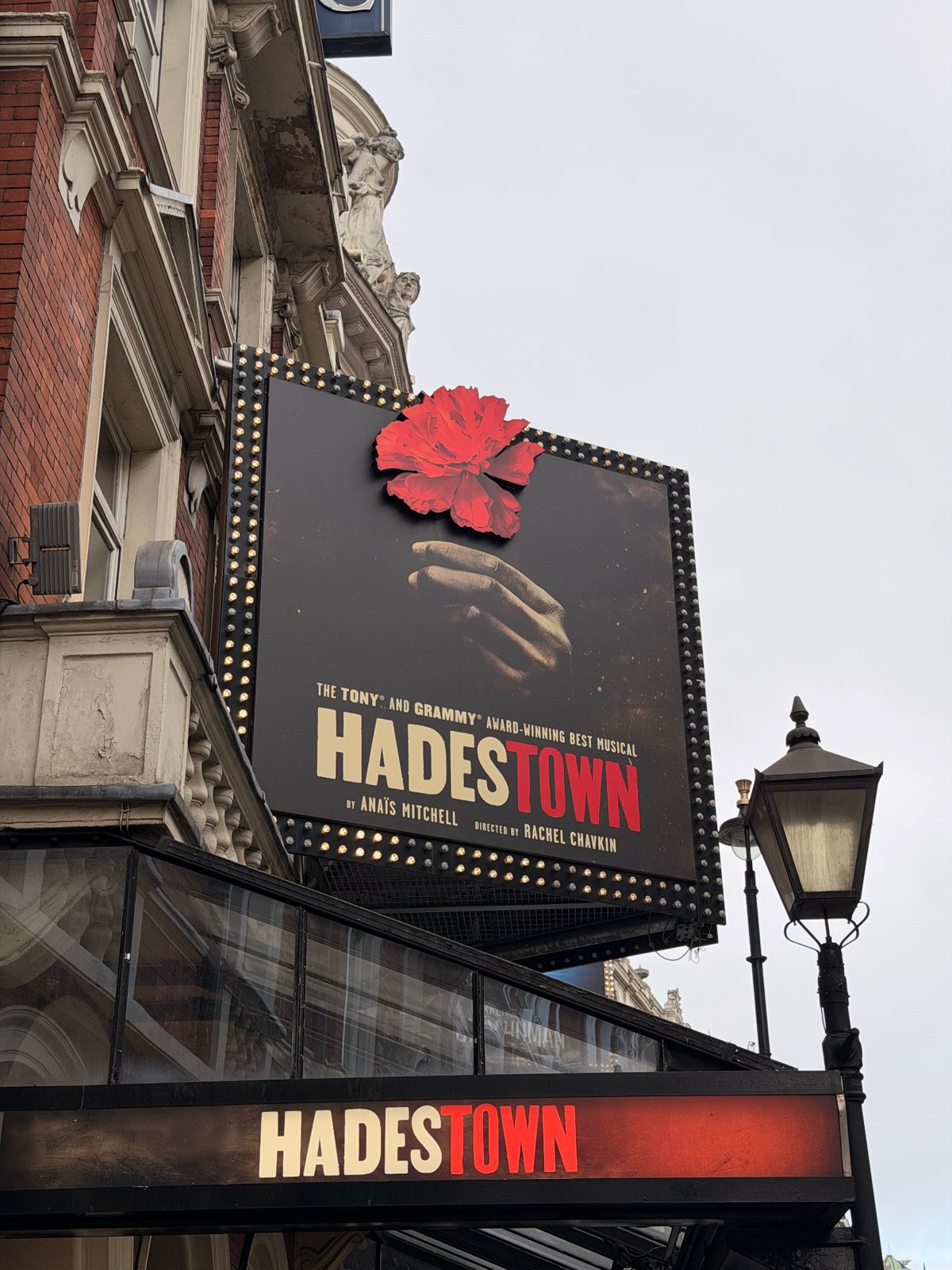
In 2019, when I walked across the stage of Hadestown on Broadway, I was interested in discovering the place where that universe was built. Seven years later, in London, what impressed me most was understanding how the same theatrical language could transform an ancient story into such a contemporary reflection on freedom, power and the human capacity to resist resignation. Between those two moments there is a red flower I still keep, a few photographs and the memory of people I met along the way. But there is also a clearer awareness that Theatre is not exhausted by the space in which it takes place, or the time for which it remains illuminated. A work can continue to develop within us, find other meanings and awaken questions we were not ready to ask when we first encountered it.
Orpheus cannot change the fate we know, but that does not make his song useless. On the contrary, perhaps it is precisely that impossibility that gives it its most human dimension. There are stories that do not teach us to win, nor offer us the reassurance of a definitive solution. They teach us to recognise the value of continuing to search, of questioning what seems established, and of not allowing the knowledge of a possible failure to take away our willingness to act before we have even begun.
In 2019, I left that stage with a flower. In 2026, I left the audience with an idea rather less easy to keep: the world does not begin to change when we find all the answers, but when someone manages to make us question the questions we have stopped asking.
More information about Hadestown.
The possibility of this story reaching new audiences took on another dimension with Hadestown: The Musical, a live stage capture of the production at London’s Lyric Theatre, released in UK cinemas on 13 October 2026. This is a recording of the stage production, not a film adaptation. For anyone looking for Hadestown cinema screenings in Portugal, the official information reviewed as of 24 October 2026 does not confirm a Portuguese release date; that does not rule out future screenings.
The relationship between a work, its communication and the audiences it reaches also runs through my cultural marketing projects. For a complementary reading of campaign figures, the Box Office Simulator explores ROAS, advertising break-even and occupancy — without mistaking those indicators for the value of the artistic experience.
Share this note
How would you rate this note?
…
Get the next notes
I write about culture, audiences and strategy. No fixed schedule, no noise.