The Permission to Believe
What Disneyland Paris reveals about experience, ritual and the making of magic
Culture, Experience and AudiencesAndré Marques Moreira26 min read
Published 17 August 2026
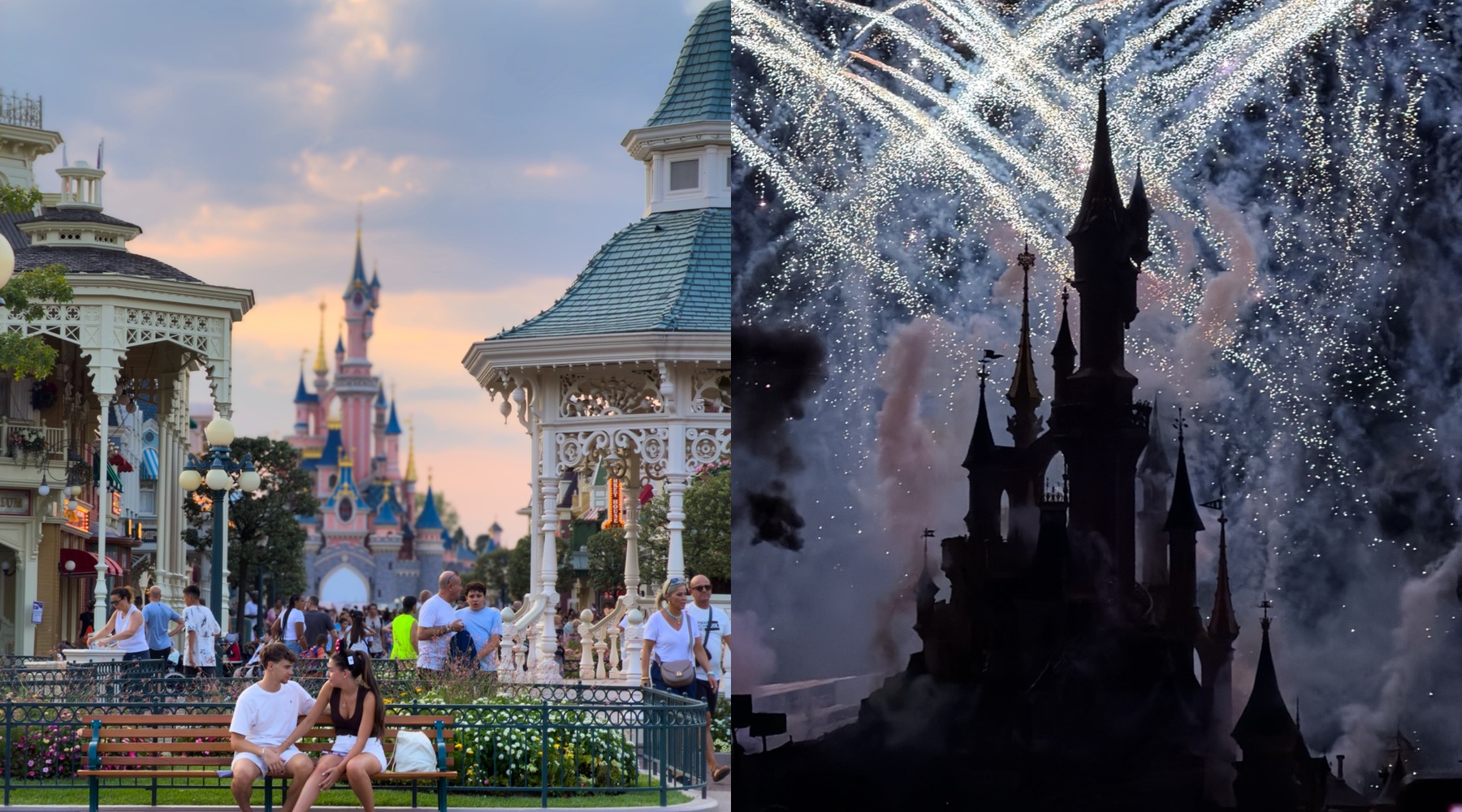
There is something particularly revealing about visiting Disneyland Paris on a day of extreme heat when what you want to think about is the way Disney builds what it calls magic, because few organisations have developed such a meticulous relationship with the control of experience, and few variables are at once so elementary and so indifferent to that control as the weather.
Disney can decide what we see as we cross the entrance to the park, the music we hear as we walk down Main Street, the architecture that frames our gaze, the planting that hides whatever should not belong to the landscape, the routes taken by the characters, the way queues are organised, the lighting that transforms a building at nightfall, and even the manner in which its employees present themselves to those who visit. It can study behaviour, anticipate needs, refine processes over decades and build an extraordinary continuity between narrative, space, service and consumption; what it cannot do is prevent the temperature from being too high and the visitor, at a certain point, from ceasing to think about the castle in order to start looking for the next patch of shade.
That, in part, is how I experienced the park.
The heat made the visit different from the one I had imagined and introduced a physical dimension that the usual discourse on customer experience sometimes tends to forget: we do not move through an experience with the mind alone, but also with a body that feels heat, hunger, thirst, fatigue, pain, impatience and the need to stop. In her work on servicescapes, Mary Jo Bitner showed how the physical conditions of a service environment shape the behaviour both of those who use it and of those who work within it, drawing attention to a dimension that becomes particularly evident in a theme park, where the environment does not merely contain the experience but forms part of what is actually being sold.
At Disneyland, the space itself takes part in the narrative, which is why a change apparently external to the experience, such as the heat, ends up interfering with it far more deeply. During the visit we came across areas where water curtains and misting systems had been installed in an attempt to offer some relief, while the presence of characters outdoors was far smaller than I had expected. I later learnt that, faced with the high temperatures of those days, changes had been introduced to the entertainment programme: specialist outlets announced that A Million Splashes of Colour would be moved to Videopolis between 11 and 14 August, although, as a visitor, I did not find information clear enough to allow me to establish whether that solution actually took place. Disneyland Paris itself states that its shows and parades may be adapted, postponed or cancelled when weather conditions or safety reasons require it.
The distinction is not irrelevant. An operational adaptation can be perfectly reasonable and still remain almost invisible to the person visiting the park; in that case, what the organisation experiences as a response to a contingency may be experienced by the consumer simply as absence. It is a small difference in appearance, but an important one when we think about experience.
Solving a problem is not quite the same thing as managing to integrate the solution into the experience of the person living through it.
And perhaps it was precisely the heat, more than any moment of apparent perfection, that helped me understand Disney's sophistication more clearly.
Magic begins long before it looks like magic
Some years ago, when I read Lee Cockerell, former head of operations at Walt Disney World, what interested me above all was the idea that what the visitor interprets as magic rarely arises from a single extraordinary gesture; on the contrary, it is the consequence of an organisational culture that turns leadership, training, cleanliness, maintenance, autonomy, attention, safety and consistency into a kind of invisible infrastructure of the experience. In his books on leadership and service, Cockerell returns precisely to that relationship between the quality of the internal organisation and what the visitor eventually receives on the outside.
This perspective becomes particularly interesting when placed alongside Erving Goffman, who in The Presentation of Self in Everyday Life used the language of Theatre to interpret social life, distinguishing the region in which performance takes place before an audience from the one in which participants can prepare, correct or set aside the character they present.
At Disney, the metaphor becomes almost uncomfortably literal. Employees are Cast Members, there are carefully separated zones between what the visitor may and may not see, there are costumes, characters, sets, routes, entrances and exits, and there is an extraordinary amount of work whose whole purpose is not to present itself as work. Cleaning must happen without occupying the centre of the experience, security must be effective without turning the park into an intimidating place, the movement of thousands of people has to be ordered without our feeling the permanent presence of a logistical operation, and technology must produce wonder without requiring us to think too much about the equipment that makes it possible.
Perhaps that is one of the most interesting aspects of magic as an organisational construction: the better the structure that produces it works, the less aware we are of its existence, because what we see is the effect, while what tends to disappear is precisely the effort that made it possible.
This is also why exceptional situations are so revealing. When a character cannot appear because of the heat, when a show has to be adapted, or when a water curtain provisionally becomes part of the landscape, what usually remains backstage moves closer to the surface and reminds us that the coherence of that world depends on decisions constantly taken by an organisation that has to negotiate with reality.
At that moment, service culture stops being a pleasant abstraction about customer care and becomes a far more serious question: faced with the conflict between fully preserving the promise made to the visitor and protecting the people who make that promise possible, which of the two should prevail? The answer seems obvious, but it is precisely the ability to take that decision without undermining trust in the experience that distinguishes an organisational culture from a mere set of procedures.
Magic, in that sense, does not consist in preventing reality from entering, but in knowing what to do when it does.
When Mickey walks past us
For much of the day I did not find the characters moving through the streets as I had imagined before the visit and, perhaps because of that absence, the moment when they finally appeared acquired an intensity it would hardly have had if their presence had been constant. We were already approaching the exit when Mickey, Minnie and Goofy walked past us, accompanied and framed by an organisation discreet enough for their movement to seem spontaneous without ever genuinely ceasing to be controlled.
The transformation of the people around us was almost immediate. Phones went up, voices called out to the characters, attempts multiplied to win a glance, a gesture or a brief reaction that might make personal an event shared by dozens of strangers and, for a few seconds, I had the very clear sense of watching three celebrities go by.
The comparison is less superficial than it seems, because a celebrity is distinguished not only by being recognised, but by the extraordinary value that even the smallest amount of their attention comes to acquire. A glance that in any other circumstance would carry no importance becomes memorable because it came from that person; an ordinary gesture turns into an event because it was directed at us. Something similar was happening as Mickey, Minnie and Goofy passed by, with a difference that makes the phenomenon even more interesting: practically every adult standing there knew that those characters were being performed.
Nobody needed to be deceived for the encounter to work.
It is precisely here that the phrase suspension of disbelief, so often invoked to explain the relationship between spectator and fiction, begins to seem insufficient. We do not truly stop knowing that there is a person inside the character, nor do we literally believe that Mickey Mouse decided to take a walk through Disneyland Paris that late afternoon; what we do is perhaps intellectually more interesting, because we agree to take part in a collective convention in which that knowledge becomes temporarily irrelevant.
We do not necessarily suspend reason; we suspend the need to assert it.
Context is what makes that transformation possible. Meeting someone dressed as Mickey on an ordinary street would produce a completely different reading, because everything that legitimises the character would be missing: the castle, the music, the architecture, the other people, the very route we followed to get there and, above all, the shared awareness that we have entered a place where certain rules of everyday life may be temporarily replaced by others.
It was while watching that collective reaction that a possible inversion of Walter Benjamin occurred to me. Thinking about the technical reproduction of the work of art, Benjamin questioned the loss of what he called aura, associated with the singular and unrepeatable presence of the work in a particular place and moment; in his reading, the possibility of mass reproduction altered the relationship between presence, authenticity and experience.
Mickey is probably one of the most reproduced images in contemporary popular culture. He exists in films, series, advertising, clothing, toys, mugs, apps, photographs and an almost incalculable quantity of objects, which should in principle lead to the extreme banalisation of his image. And yet almost the opposite movement occurs when that image takes on a body inside the space we culturally recognise as the place where it belongs: what we have seen reproduced thousands of times recovers presence.
I do not, of course, intend to turn Benjamin into a theory about theme-park characters; the analogy interests me precisely for the tension it reveals. An endlessly reproduced image can produce singularity once again when it appears in a context that restores to it a here and a now, ceasing, for a few seconds, to be merely another representation of Mickey in order to become, in the spontaneous language of those standing around, simply Mickey.
Reason knows the difference is constructed, but emotion responds as though the difference were real, and perhaps a significant part of Disney's cultural value lies precisely in that capacity to convert mass-produced symbols into personal events.
When the park becomes Theatre
It was in the shows that this ability to organise attention and memory became, for me, most evident.
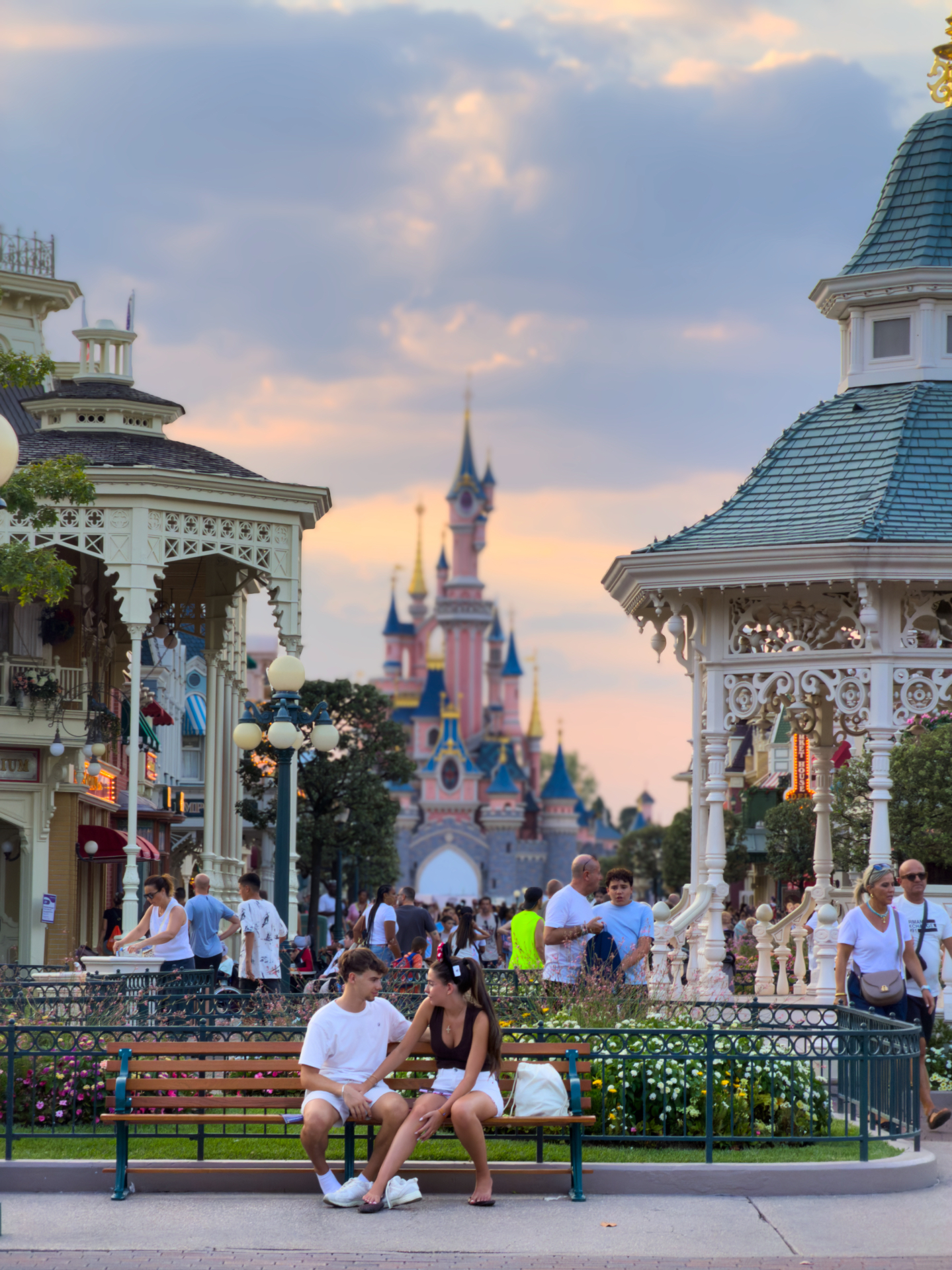
Mickey and the Magician starts from an extraordinary narrative advantage: it does not need to teach the spectator the stories it presents, because those stories, to a great extent, already exist inside them. The entrance of a character, a piece of music, a change of light or a scenic element is enough to activate entire worlds we know from other places and other moments of life; what happens on stage is therefore only part of the show, because another part happens in the memory of the person sitting in the auditorium.
It was there that Tim Lutkin's work caught my attention in particular. Lutkin designed the lighting for Mickey and the Magician and, in an interview published by Disneyland Paris itself, explained his work through two functions that seem to me essential in understanding the show: directing the audience's attention towards what should be seen and, through light, helping to change not only the visual perception of the scene but the way the spectator feels inside the theatrical space.
There is in this idea a particularly fertile connection between Theatre and communication.
In digital marketing we have grown used to treating attention as a unit to be won, measured, bought and optimised, turning seconds of dwell time, views or click-through rates into indicators of human interest. Theatre reminds us, however, that attention is a far more complex material: it can be guided without being forced, prepared before being captured, diverted, concentrated, suspended and, above all, charged with meaning through what happens before and after the gaze reaches its destination.
Theatre reminds us that attention is not merely a metric: it is dramaturgical material.
The lighting of Mickey and the Magician does not serve only to show. It creates hierarchies, establishes transitions between worlds, decides when a memory begins to emerge and when it should fade, guiding the spectator through stories that do not need to be told in full because they are completed by the emotional repertoire each person brought with them. Disney therefore works with something more valuable than brand recognition, because it works with an embodied memory that does not have to be rebuilt each time a character walks on stage.
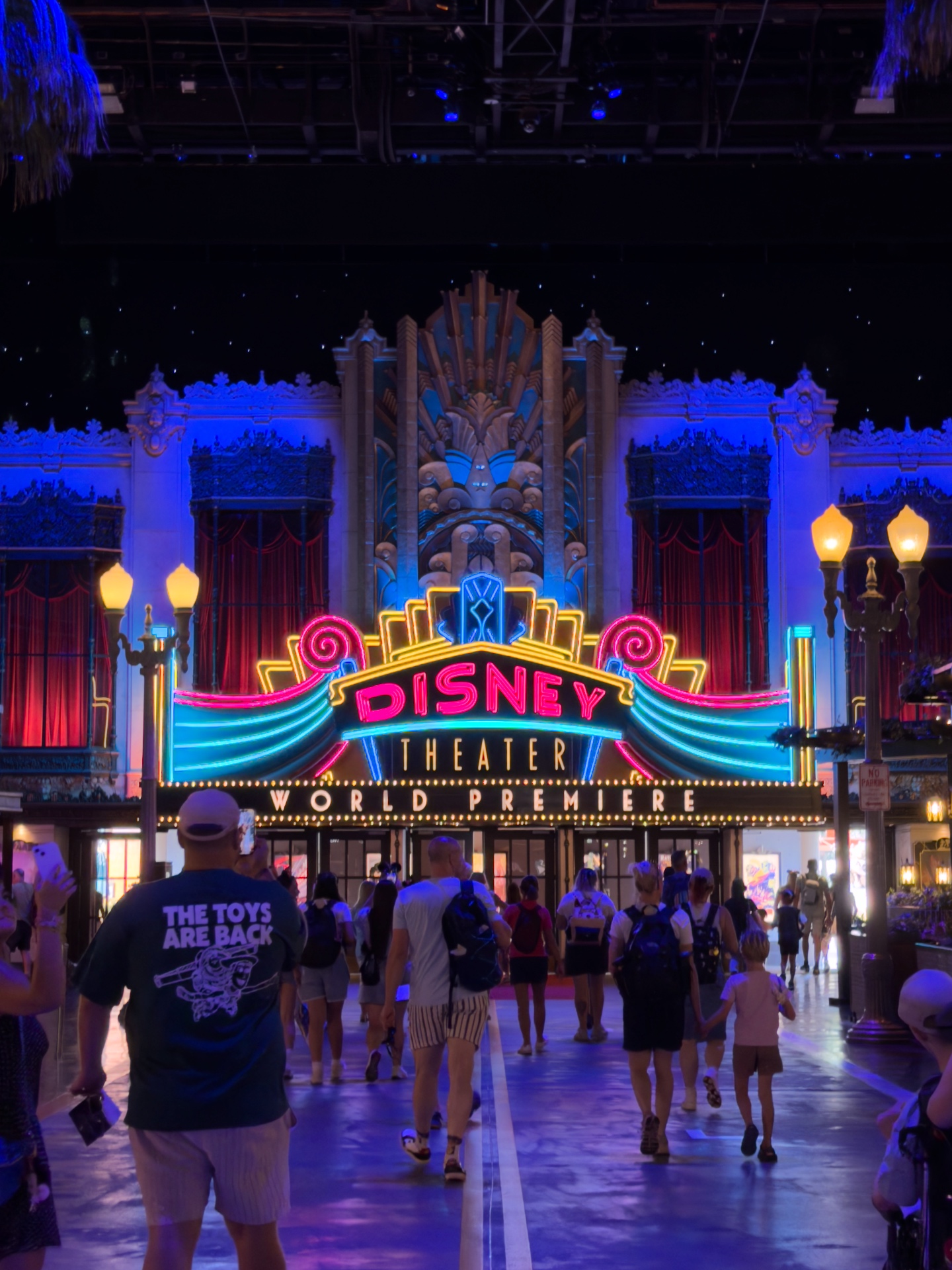
When the same Tim Lutkin takes on the creative direction of Disney Tales of Magic, the night-time show that closes the day at Disneyland Park, that relationship between attention, memory and emotion acquires another scale. It is not only Sleeping Beauty Castle that receives the visual narrative; Main Street also carries the projections, while light, fountains, pyrotechnics, lasers and drones make the park itself part of the staging. Lutkin described the creation of the show as the search for a coherent narrative arc for the idea of “magic”, leading the narrative from a magic that is initially visual and external towards forms of magic bound up with feelings, relationships, desires and the characters' capacity to follow their own path.
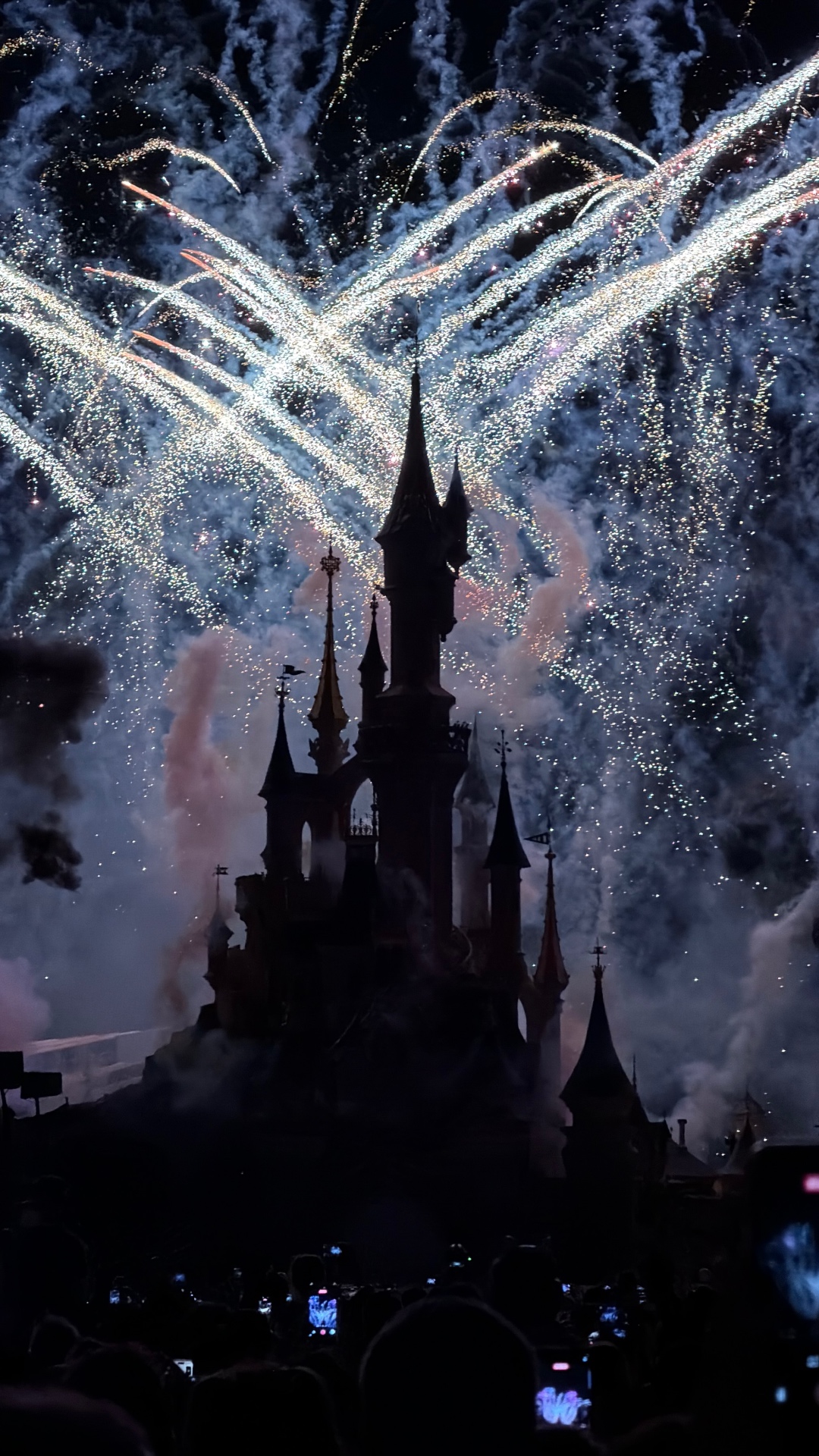
That shift matters, because it prevents the show from being reduced to a technological demonstration. Technology impresses, naturally, but when there is no emotional structure capable of organising it, it quickly becomes a catalogue of effects. What makes that finale more interesting is precisely the way different languages are subordinated to a dramaturgy: the castle stops functioning merely as architecture, the street stops functioning merely as circulation, the sky becomes scenic space, and thousands of people who spent the day following different routes end up, for a few minutes, turned in the same direction.
It is hard not to think here of Victor Turner, though with care not to transfer mechanically to a theme park concepts developed from the anthropological study of ritual. Turner used the ideas of liminality and communitas to think about states in which the usual structures of social life are temporarily suspended and a particular form of relationship emerges between those passing through the same experience.
A crowd standing before an illuminated castle is obviously not a rite of passage in the original anthropological sense, but the comparison allows us to recognise something that audience figures rarely capture: for a few minutes, thousands of strangers agree to take part in the same narrative, to recognise the same music, to wait for the same events and to react collectively to images that belong at once to private memories and to a shared popular culture. The show thus becomes more than what each spectator sees individually, because it produces a temporary form of emotional synchronisation between people who will probably never meet again.
When emotion becomes economy
It would be naive to speak of this emotional construction while ignoring that all of it happens inside one of the most sophisticated commercial machines in the world.
Disney's strength lies precisely in not requiring us to choose between the cultural and the economic dimension, because the two have been deeply integrated. The experience leads to consumption and consumption extends the experience; we find shops inside the narratives, characters turned into objects, meals embedded in themed environments and an extraordinary quantity of products whose material usefulness hardly explains, on its own, the desire to own them.
When B. Joseph Pine II and James H. Gilmore popularised the idea of an experience economy in 1998, they argued that companies could create a new layer of value by no longer offering only goods or services and instead staging memorable events for which consumers would be willing to pay. Disney is almost inevitable when we think along these lines, but perhaps what it does in a particularly sophisticated way is not to stop at staging the experience: it also creates the instruments through which we can materialise it once it has ended.
A photograph in front of the castle therefore stops being valuable merely as a visual record of that place and that instant, because it starts working as intimate proof of an experience we want to keep; a pair of ears can be at once a piece of merchandise and the visible mark of a temporary participation in a world that authorises other behaviours; a soft toy, in turn, may begin as an entirely ordinary commercial object and acquire, with the passing of time, the capacity to recover a journey, a person, an age or a feeling that no longer exists in the same conditions. What these objects share is not a particular material function, but the possibility of becoming vessels for an experience that, being immaterial and transient, looks for somewhere it can remain.
It is at this point that Clotaire Rapaille's readings of cultural codes still strike me as useful, not because there is a universal “Disney code” that neatly explains such varied behaviours, but because The Culture Code insists on the distance that can exist between the objective function of a thing and the cultural meanings we attach to it. Photographing the castle, wearing a pair of ears or meeting Mickey matter not because of the material usefulness of each gesture, but because they help mark that this moment belongs to a different category from everyday life and deserves, precisely for that reason, to be separated from the undifferentiated flow of time.
That is also one of the functions of ritual. A bottle of champagne does not in itself contain the celebration, just as a photograph beside the castle does not contain the journey; in both cases, however, an object or a gesture becomes the culturally recognisable way of declaring that a given moment should not be treated like all the others. Ritual does not necessarily create emotion, but it helps to give it form, allowing what is inward, unstable and fleeting to become visible, shareable and, in some cases, material.
Alan Bryman offers a more critical reading of this same system when he describes Disneyization as the spread of principles associated with the Disney parks into other areas of society, organising his analysis around theming, the combination of different forms of consumption, merchandising and the transformation of service work itself into a performative dimension. At Disneyland these dimensions become particularly difficult to separate, because entertainment leads to catering, catering remains within the theming, characters extend into the objects that can be bought, and the Cast Members themselves take part in maintaining the narrative coherence that makes all the other forms of consumption possible.
It would nevertheless be intellectually unsatisfying to conclude from this only that Disney has learnt to commercialise emotion, as if noting the economic interest were enough to dismantle what happens to those who visit the park. There is of course a commercial strategy, just as there is a strategy in the choice of music for a scene, in the use of a particular light on an actor or in the composition of a campaign designed to provoke desire; recognising the intention, however, does not automatically make the effect false.
A piece of music written to move us does not invalidate the tears of those who hear it, just as lighting carefully designed to direct the gaze does not make artificial what we feel when that gaze meets the image towards which it was led. In the same way, an object bought in a Disney shop may be, at the moment of the transaction, the clearest expression of a commercial strategy, and become, years later, one of the few material things capable of recovering a memory that has meanwhile become inaccessible by any other route.
The question that seems to me genuinely interesting is therefore not whether emotion has been commercialised, but whether the existence of an architecture deliberately designed to produce it diminishes the authenticity of what we feel. And perhaps one of the peculiarities of the contemporary experience economy lies precisely in the difficulty of answering that question simply, because we can know the mechanisms of persuasion, recognise the scenography, understand that the route was designed and know that there is an economic organisation behind every detail without that knowledge necessarily making us immune to the experience.
We can know that something was designed to affect us and still be genuinely affected by it.
Disney does not resolve this contradiction; it has merely built one of the places where it becomes most visible.
From nostalgia to the possibility of a future
For a long time I thought about Disney's cultural strength mainly through nostalgia, and that explanation remains important, because few companies possess an archive of characters, music, stories and symbols capable of accompanying so many people across different stages of life. When an adult meets again a character known in childhood, they do not only recognise the character; they may also recognise something of the person they were when that story first entered their life, which means that cultural memory becomes, for a moment, a form of autobiographical memory.
There is a subtle difference between remembering Mickey and remembering who we were when Mickey meant something to us, because the first memory belongs above all to the history of a character, while the second begins to touch the history of our own identity.
But the closing show made me realise that reducing Disney to the economic exploitation of nostalgia leaves out an essential part of what the brand is trying to do. Nostalgia necessarily lives on what has already happened, whereas a considerable part of Disney's emotional vocabulary has insisted for decades on what has not yet happened: dreaming, wishing, imagining, believing, changing and continuing to look for something that does not yet exist.
Here too the conception of Disney Tales of Magic becomes revealing. Tim Lutkin explained that he sought to build the narrative around the evolution of the idea of magic within Disney stories, starting from more visual manifestations and arriving at a magic bound up with what the characters feel, the relationships they form and whatever leads them to pursue their dreams, affections and destinies. The interest of that structure lies not only in the show's thematic continuity, but in the shift it proposes between two different temporalities: memory offers the recognition the spectator needs in order to enter the narrative emotionally, but the destination of that narrative is no longer what we already know and becomes instead what we can still imagine.
Perhaps it is precisely in this passage from recognition to desire that Disney performs one of its most sophisticated cultural operations.
First it gives back what we know. A song, a character, an image or a story momentarily reduces the distance between the present and something that was once part of us; then, once that emotional security is established, the narrative gradually shifts the gaze from what we were towards what might still exist. Nostalgia thus works less as a place where we stay than as material through which we recover an emotional disposition that adult life tends to make harder: the capacity to want something before immediately submitting it to questions about its probability, usefulness or rationality.
That, perhaps, is what interested me most at the end of that day, standing before the castle.
Not the naive idea that wishing hard enough is sufficient for the world to reorganise itself around our dreams, because adult experience quickly teaches the limits of that promise, but an idea rather less childish and, for that very reason, perhaps more powerful: remaining capable of wanting something has value even when we know there is no guarantee whatsoever that we will reach it.
The dream, understood in this way, is not a prediction but an orientation: it allows us to imagine a reality different from the existing one and, precisely because of that, to preserve the possibility of acting towards it. Perhaps that is why Disney's insistence on dreams manages to survive the growing up of its audience, because what began in childhood as a promise of fantasy can return in adulthood as a symbolic form of resistance to the idea that maturity necessarily requires reducing the horizon to the probable.
A place where we do not have to prove that we know
This is also why the word “escapism” seems to me insufficient to explain what places like Disneyland offer. Escaping from reality presupposes that the aim is to forget it, whereas what I felt was rather different: reality never disappeared entirely, not least because the heat made it physically present for much of the day, but the relationship we were allowed to have with it temporarily changed.
We live in a culture in which detachment can easily be mistaken for intelligence and in which cynicism often works as a comfortable defence against the vulnerability of showing enthusiasm. Irony lets us keep a safe distance from the things we love; believing too much, being too moved or displaying wonder always involves accepting the possibility of seeming naive, as though maturity had to be demonstrated through the ability to show that we understand the mechanisms behind things and can therefore no longer be truly affected by them.
Perhaps part of Disneyland's strength lies precisely in temporarily suspending that obligation.
Adults wear ears, call out to fictional characters, queue to take photographs in front of a castle, recognise songs from films they watched as children and stand in the dark, alongside thousands of strangers, while a narrative speaks to them once again about dreams; they do all this not because they have stopped understanding the artificiality of the place, but because there that understanding does not have to be permanently deployed as a defence.
There is in this availability a deep connection with what happens in the Theatre. A spectator entering an auditorium is not unaware that the set is a construction, that the lighting was programmed, that the actors rehearsed, that the music comes in because someone determined the exact moment it should, and that there is a technical operation sustaining every second of the performance. None of that prevents a character from moving them, a fictional death from bringing tears, or a particular combination of light, word and silence from suspending, for a few instants, their awareness of the room in which they are sitting. Knowing the mechanism does not necessarily destroy the experience, because the theatrical pact never depended on ignorance, but on the willingness to accept that what we know and what we feel can coexist.
Disney seems to have carried that principle over to an extraordinarily larger spatial, organisational and commercial scale. The visitor does not merely sit before the narrative: they enter it, walk through it, eat inside it, buy objects that belong to it, meet its characters and, at nightfall, watch the architecture itself turn into a stage.
Perhaps that is why the expression “theme park” correctly describes Disneyland's economic category and still says relatively little about the cultural experience being built there.
The permission to believe
When Mickey walked past us near the exit, nobody really needed to believe that it was Mickey. When Tim Lutkin's lighting transformed the stage of Mickey and the Magician, nobody needed to forget that they were looking at scenography. When, at the end of the night, the castle stopped looking merely like a building and became a surface where stories, music, light and memory met before thousands of people, nobody needed to believe literally that dreams come true because a show says so.
A subtler availability was enough: accepting that knowing how something works does not necessarily oblige us to refuse it emotionally.
Perhaps this is where Disney becomes a particularly interesting object for thinking not only about marketing or consumer experience, but about a wider transformation in the way contemporary societies produce meaning. A great deal of economic value long ago stopped residing exclusively in the material function of objects and began to organise itself around symbols, narratives, identities, belonging, memory and emotion; at the same time, a considerable part of culture has become dependent on organisations capable of turning those immaterial dimensions into commercially sustainable experiences. The border between culture and consumption has not disappeared, but it has become porous enough that it is no longer possible to understand one without questioning the other.
Disney has taken that interdependence to an extraordinary scale because it understood that a story can become a space, that a space can become a ritual, that a ritual can become a product and that a product can return once again to the sphere of memory. The economic circuit does not eliminate cultural meaning; it feeds on it, transforms it and, in certain circumstances, also contributes to its preservation.
It is precisely this ambiguity that prevents Disney from being intellectually interesting only as an example of corporate excellence or, at the opposite extreme, as a demonstration of a wholly commodified culture. Neither of those readings is sufficient to explain why an adult who perfectly understands the commercial and theatrical construction of that world can, at the same time, feel genuine emotion when Mickey walks past or when a castle lights up.
Perhaps the answer lies less in Disney's ability to make us believe in a fantasy than in the extraordinary skill with which it builds the conditions required for our awareness of the fantasy to stop, temporarily, being an obstacle.
Seen in this way, magic is no longer the opposite of rationality, nor does it require us to abandon what we know. It is rather an interval within that rationality, a space where knowledge and enchantment can coexist without one necessarily having to destroy the other.
And perhaps that is the promise that remains after the attractions, the shows, the queues, the shops, the heat and even the inevitable imperfections of a day in a park that tries to control in detail an experience it can never control entirely. Not the promise of a world where reality disappears, but the possibility of entering, for a few hours, a world where we continue to recognise it and still feel no need to answer enchantment immediately with an explanation.
Perhaps Disney is not, after all, asking us to believe literally in magic. What it has built, across decades of stories, operations, spaces, characters and rituals, is something more deliberate and perhaps harder to produce: a place where an adult does not have to choose between understanding the artifice and being touched by it. We can know that the castle is scenography, that Mickey is a character and that every instant was meticulously prepared, and still allow all of it to give us back, for a few hours, the capacity for wonder. The permission to believe does not consist, then, in forgetting what we know, but in recognising that knowledge does not have to destroy enchantment.
Was this note useful?
Get the next notes
I write about culture, audiences and strategy. No fixed schedule, no noise.