FÁTIMA — Ópera-Rock
Finding a contemporary language for a story that already belonged to collective memory.
01
The project
Fátima occupies a place hard to compare with any other subject in Portugal. It is at once a place of pilgrimage, a historical event, a family memory, a national symbol and an international destination. For millions of people it is not simply a familiar narrative: it forms part of an intimate relationship with faith, with family, or with identity itself.
That closeness made the project especially demanding. Communication that leaned too heavily on religion could narrow the reading of the show and alienate audiences with no connection to faith. An approach that was too secular, too promotional or too provocative could seem incapable of understanding what the subject meant to those who believed.
Filipe La Féria’s vision sought to cross that divide. The show did not dispel the mystery, but nor did it set aside doubt, historical context, political conflict and human suffering.
The apparitions arose within a Portugal deeply marked by rural poverty, by participation in the First World War, by hostility between republican power and the Church, by illness and by the fragility of families. The story of the shepherd children was also the story of mothers who feared losing their sons to the war, of a people searching for answers to their suffering, and of the political, social and religious forces that tried to interpret, control or combat what was happening.
The music, the dramaturgy, the visual dimension and the rock-opera format made it possible to revisit a familiar story through a new experience. The show brought together historical epic, family drama, ideological conflict, spirituality, popular humour and the language of large-scale musical theatre.
The campaign therefore had to communicate respect, complexity and reinvention at the same time.
02
The question to resolve
The first question was how to create desire around a subject that could not be treated as a straightforward cultural property. Fátima was not merely the subject of the show. It was a living reference in the experience of many of its potential audiences.
It was necessary to show that the production respected that dimension without presenting it solely as a work intended for believers. The story contained religious elements, but also questions about childhood, fear, power, war, freedom, persecution, suffering, hope, doubt and collective transformation.
The rock-opera format created another tension. For some audiences it represented a language capable of renewing and enlarging the story. For others it could seem unexpected, or even incompatible with the solemnity associated with the subject.
The communication had to explain that choice without adopting a defensive position. The modernity of the show was not used as provocation, nor as an attempt to produce surprise through contrast. It was an artistic language for making contemporary the conflicts, emotions and questions running through the events of 1917.
The show needed to be recognised as a major theatrical production about Fátima, and not as a religious ritual transposed to the stage, a musical catechism or a superficial modernisation of a sacred narrative.
It was equally important to communicate that the dramaturgy did not present a simple opposition between believers and non-believers. The Administrator of Ourém, the Church, the journalists, the families, the pilgrims and the shepherd children themselves related in different ways to what was happening. Each character carried their own convictions, interests, fears and contradictions.
The production did not tell the spectator what to believe. It placed on stage the forces that contested the meaning of Fátima.
03
The campaign idea
The campaign began from the idea that a deeply familiar story could still be seen in another way.
Rather than trying to settle the question of faith, the communication acknowledged the plurality of relationships the audience could form with the show. For some, Fátima would be a spiritual experience. For others, a historical narrative. For others still, a large-scale musical production about an event that changed the identity of a place and Portugal’s image in the world.
The rock-opera format was presented as part of that new perspective. The music, the dramatic intensity and the visual scale brought the events of 1917 closer to a contemporary audience, without erasing the mystery or reducing the story to a single explanation.
The campaign also sought to reveal that the show neither began nor ended with the apparitions. It showed the Portugal that preceded them, the tensions they provoked and the human, social, religious and political consequences that followed.
The promise was not to tell audiences what they should believe. It was to invite them into a story that continued to provoke faith, doubt, emotion and questioning more than a century later.
04
How it took shape
My work was carried out in close collaboration with Filipe La Féria, seeking to understand and translate a very specific vision for the show.
Filipe La Féria did not set out to create a conventional religious representation. He wanted to build a great Portuguese rock opera, in which faith, history, politics, suffering, humanity and spectacle could coexist without simplification.
That vision had to be translated into communication capable of preserving the human, historical and spiritual complexity of the subject while revealing the musical, visual and theatrical dimension of the production.
The campaign could not confine itself to reproducing religious imagery, concealing the rock-opera character that distinguished the project, or communicating only the Miracle of the Sun and the apparitions. It was necessary to reveal the show as a large-scale narrative, shaped by war, poverty, the conflict between reason and faith, institutional violence, illness, loss and hope.
The work spanned positioning, copy, the development and adaptation of visual materials, music and video content, social media, newsletters, press, Meta and Google campaigns, and communication with organised groups, partners, tourism and international audiences.
As production stills, musical excerpts, costumes, sets and performance moments emerged, the communication was able to make more concrete the relationship between the familiar story and the artistic language chosen to tell it.
Content from the show itself was especially important in reducing the distance created by the phrase “rock opera”. It made it possible to show that the music and the spectacle did not diminish the subject, but amplified its dramatic, historical and emotional force.
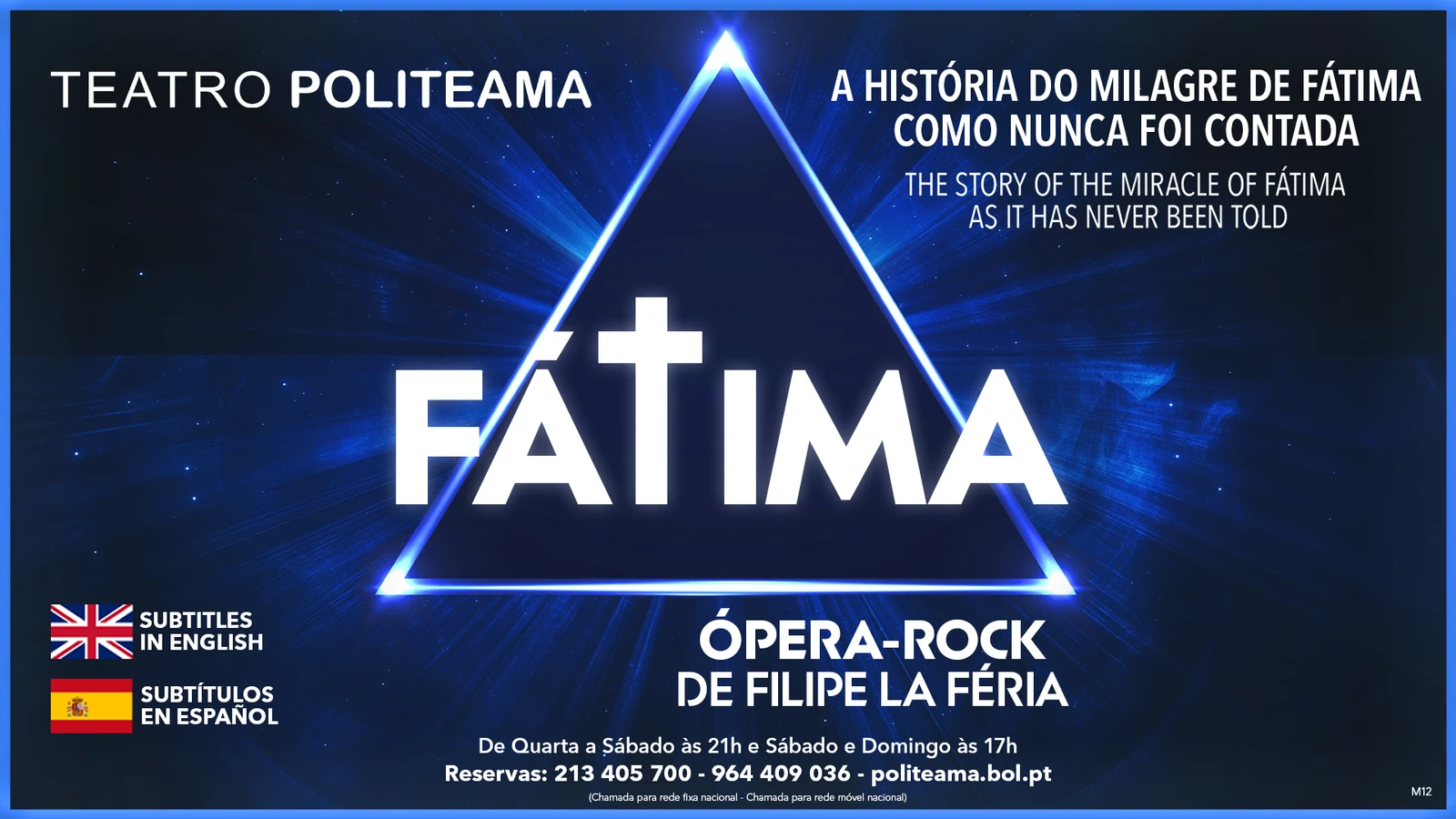
The availability of English and Spanish surtitles was also built into the campaign. This was not merely practical information. It helped to establish the show as a production accessible to the thousands of international visitors who recognised Fátima as a place of religious, historical and cultural significance, even without speaking Portuguese.
05
Audiences and channels
The campaign addressed audiences with very different relationships to the subject: believers, pilgrims, musical theatre audiences, people interested in Portuguese history, organised groups, regional communities, religious and cultural tourism, and international visitors.
For audiences with a religious connection, respect, emotional fidelity and the way the events would be represented were essential. For theatre audiences, greater weight fell on the music, the dramaturgy, the cast, the stage design and the scale of the production.
For audiences interested in history, it mattered to show that the production also portrayed the Portugal of 1917, the First World War, the confrontation between the Republic and the Church, and the social conditions in which the apparitions took place.
For international visitors, linguistic accessibility and the cultural singularity of the production were central arguments. The show offered a way into one of Portugal’s most globally recognised stories through the language of musical theatre.
Meta made it possible to work on discovery, emotion, imagery and message repetition. Google captured active demand related to Fátima, theatre, musicals, tourism and cultural programming. Email and direct relationships with organised groups reached audiences with more structured buying habits.
The press, institutional partners and tourism contacts helped to frame the project beyond conventional advertising, establishing it as a theatrical, cultural and touristic event.
Segmentation was especially important, because the same advertisement could not speak in the same way to someone moved by faith, to a musical theatre spectator, to a person interested in Portuguese history and to a foreign visitor.
The unity of the campaign did not come from repeating the same message. It came from offering different ways into the same work.
06
What the box office revealed
Fátima’s universal recognition did not mean the show was automatically understood. Audiences knew the subject, but still needed to grasp what kind of experience was being proposed, what role the music played and how the story would be treated.
Demand helped to show that different arguments served different purposes. The name Fátima created immediate recognition. Filipe La Féria’s signature reinforced confidence in the scale and quality of the production. The description “rock opera” aroused curiosity, but could also raise questions.
Production stills, the music, the costumes, the sets and explanatory content helped to reduce that distance. They showed concretely that this was not a religious ceremony, but a major theatrical production built from an event deeply bound to Portuguese history and identity.
The communication had to respond not only to interest, but also to doubts. What did a rock opera about Fátima mean? Was it a religious show? Was it suitable for those who did not believe? Did it respect the events? How present were history and politics? Could foreigners follow it?
Those questions were not obstacles external to the campaign. They were information about what audiences needed to understand before buying.
The response to the content also showed that an important part of trust emerged when audiences realised the show did not seek to impose a single interpretation. The dramaturgy placed in dialogue the faith of the shepherd children, the reason of the Administrator, the reservations of the Church, the gaze of the press and the despair of a people marked by war, hunger and illness.
The show did not push faith aside, but nor did it eliminate doubt. That openness allowed people with very different convictions to find a possible relationship with the work.
The box office and the response to the content thus made it possible to understand which arguments turned recognition of the subject into confidence in the show. They also showed that, with material carrying such symbolic weight, explaining the artistic proposition could matter as much as promoting it.
07
What remained from this work
FÁTIMA — Ópera-Rock confirmed that communicating a sensitive subject did not mean communicating with fear. It meant understanding with rigour what could not be trivialised, and finding, from there, a language capable of enlarging the experience.
The work showed that respect and contemporaneity did not have to sit on opposite sides. The rock-opera format, the theatrical scale and the visual language could renew the way the story was seen without diminishing the importance it still held for millions of people.
It also showed that spectacle was not necessarily a form of simplification. When it emerged from a coherent dramaturgical reading, it could make visible the violence of war, the force of crowds, the fragility of children, the ideological conflict and the collective dimension of an event that began in a remote place and would come to be known around the world.
Audience development was not only about seeking people similar to those who already bought tickets. It could mean finding different ways into the same work, allowing faith, history, music, tourism and cultural curiosity to coexist without being confused with one another.
Above all, one idea remained: faced with a story that millions of people believed they already knew, the real challenge was not to communicate a miracle. It was to show that the story could still be lived as theatre, as emotion and as contemporary experience, without losing its human depth or its respect for those who found faith within it.
“A cultural campaign does not begin when the poster is published. It begins when we decide why someone should want to be there.”