Carmen Miranda — O Musical
Revealing the woman behind the icon, without diminishing the spectacle that made her unforgettable.
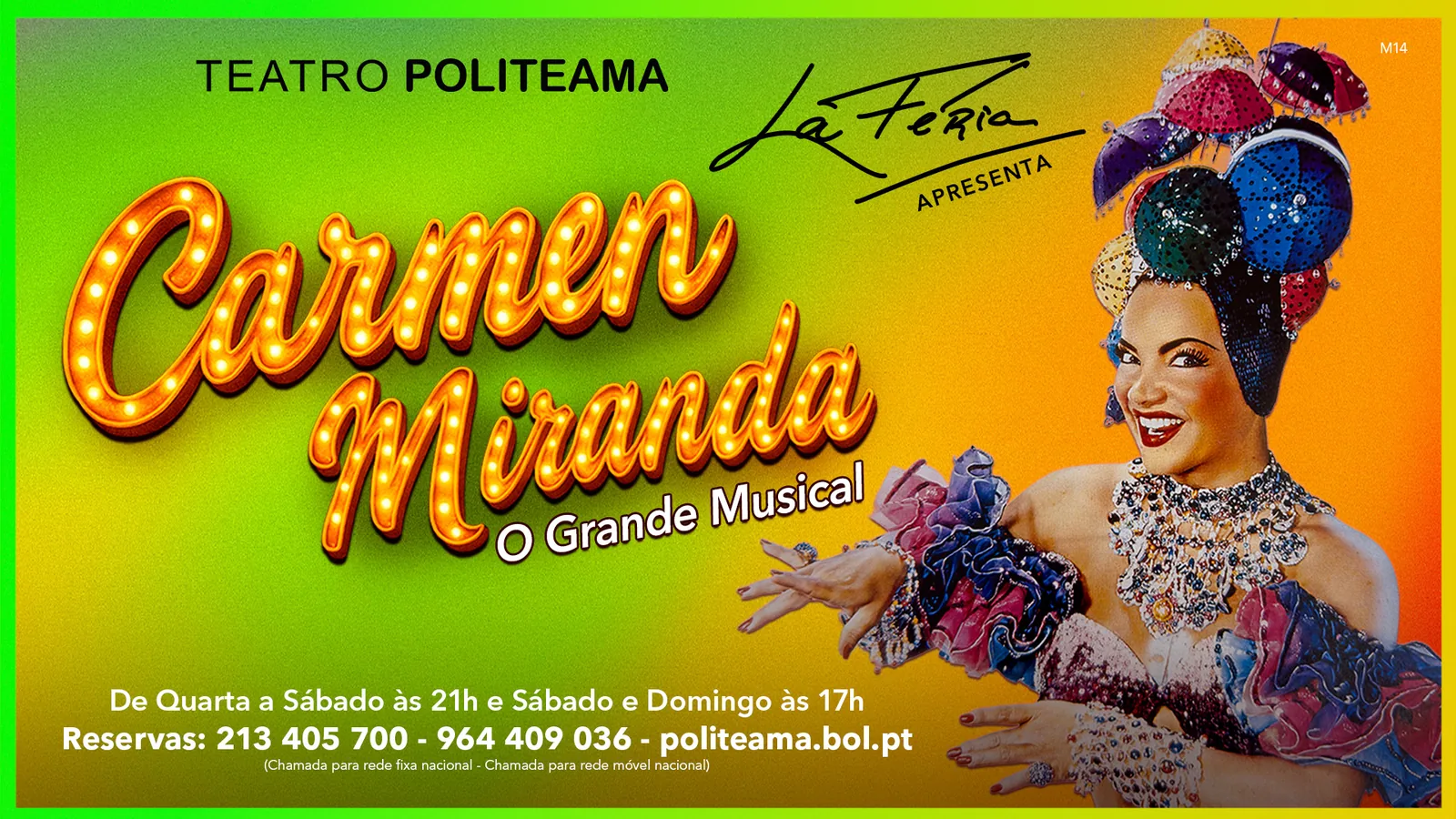
01
The project
Carmen Miranda held a singular place in Portuguese, Brazilian and international memory. Her image travelled across generations and remained recognisable even to those who knew nothing of her biography, her films or the true scale of her career.
That familiarity was an advantage, but also a difficulty. When a figure appears to belong to common knowledge, audiences may feel there is nothing new left to discover. The campaign therefore had to work against a kind of excess of recognition: starting from the icon in order to give complexity back to the person.
Filipe La Féria’s vision for the show was highly specific. This was not an austere biography or a documentary reconstruction, but a life told through the scale, emotion and language of grand musical theatre. The set design, the costumes, the choreography and the musical dimension were not decorative elements laid over the narrative. They were part of how that narrative would be felt.
The show therefore needed to be communicated as a major theatrical experience and, at the same time, as the discovery of a woman whom fame itself had ended up concealing.
02
The question to resolve
The first challenge was to turn recognition into curiosity. Being able to identify Carmen Miranda did not necessarily mean wanting to know her story, particularly when the image seemed to have been repeated until it became almost independent of the woman who created it.
The second challenge was to communicate the visual dimension of the production without reducing it to a promise of colour and exuberance. The monumental sets, the sumptuous costumes, the music and the movement were essential arguments, but they had to lead audiences towards a narrative rather than merely a succession of recognisable images.
The campaign also had to speak to audiences who related to Carmen Miranda in very different ways: through Portuguese memory, Brazilian identity, music, cinema, fashion, popular culture or simple curiosity about a great biography brought to the stage.
Each audience needed to recognise the Carmen they already knew, while sensing that the show had something new to reveal to them.
03
The campaign idea
The campaign grew from a central idea: everyone recognised Carmen Miranda, but few genuinely knew the woman behind the image.
The iconic silhouette, the turbans, the costumes and the visual exuberance were neither rejected nor held at arm’s length. They were part of the character’s identity and of Filipe La Féria’s own vision for the production. They were used as a first level of recognition and as a promise of the spectacle audiences would find on stage.
From there, the communication gradually opened up another dimension: the life beyond the symbol, the person beyond the character, the emigrant beyond the star, and the human cost that accompanied an extraordinary international rise.
The show was presented as an opportunity to meet a familiar figure again from a less predictable perspective. It was not simply about remembering Carmen Miranda or reproducing her best-known numbers. It was about understanding how that image was built, what it represented, what it achieved and what it may have concealed.
The promise was not only to see Carmen Miranda on stage. It was to enter the spectacular world she created and discover the life that existed behind it.
04
How it took shape
My work was developed in close collaboration with Filipe La Féria, following a very concrete artistic vision for the show and seeking to translate it into a communication language that was coherent, recognisable and able to reach distinct audiences.
That collaboration required understanding not only what the show was telling, but how Filipe La Féria wanted it to be experienced: as a great musical production, visually exuberant, emotional and deeply rooted in the tradition of popular spectacle.
The work spanned positioning, copy, the development and adaptation of visual materials, posters, social media content, newsletters, press, digital campaigns, and communication with groups, schools, partners and institutional contacts connected to Carmen Miranda’s memory and legacy.
The communication balanced two languages. One more immediate, built from colour, costumes, cast, music, sets and the scale of the production. Another more narrative, able to introduce the biographical conflicts and the human dimension of the show.
As production images, musical numbers, costumes, moments of performance and details of the set design emerged, the campaign was able to move from initial recognition to concrete proof of the theatrical experience. Audiences no longer saw only a promise about Carmen Miranda; they began to grasp the scale of the world that had been built to tell her story.
The communication thus evolved between two questions: what did audiences already know about Carmen Miranda, and what had they not yet realised they did not know?
05
Audiences and channels
The campaign addressed musical theatre audiences, people connected to music and cinema, the Portuguese and Brazilian communities, cultural tourism, schools, organised groups and those drawn to great biographical narratives.
Each audience found a different way in. For some, Carmen Miranda belonged to family memory; for others, she represented a reference point of Brazilian cultural identity; for others still, she was above all a visual image known through cinema, fashion and popular culture.
Meta Ads, Google Ads and TikTok Ads made it possible to work on different moments in the relationship with the audience. Meta played a central role in discovery, visual recognition and message repetition; Google captured active demand and converted interest that had already formed; TikTok brought the show closer to audiences oriented towards video, music, movement and discovery content.
Email and direct relationships with groups activated audiences with established cultural habits. Press and television helped restore context and depth to the figure. Performers, partners and institutional contacts widened the legitimacy and circulation of the project.
Segmentation did not serve only to distribute advertising. It served to acknowledge that the same figure occupied different places in each audience’s memory.
06
What the box office revealed
A well-known name reduced the initial distance between audiences and the show, but it did not remove the need to build a concrete reason to buy. Recognition generated attention; conversion depended on demonstrating that there was a new story and a large-scale theatrical experience inside that familiar image.
Reading demand also showed that different content served distinct purposes. Carmen Miranda’s image created immediate recognition. Filipe La Féria’s name and the cast reinforced trust. The costumes, the sets and the musical numbers demonstrated scale. The biographical content added curiosity, conflict and depth.
In the more difficult periods, regular and continuous investment in Google Ads, Meta Ads and TikTok Ads proved essential to keep the production present, renew demand and prevent the communication from depending solely on organic momentum or initial novelty.
Continuity mattered as much as intensity. A long-running production could not communicate only when there was an opening night, a new image or a piece of news. It had to remain visible through the quieter stretches, when attention dipped, new cultural offers appeared and audiences postponed their decision.
The box office therefore showed that the fame of the title was not a permanent guarantee of demand. It had to be continually reactivated through new arguments, new images and sustained investment.
More than confirming the strength of the name Carmen Miranda, the audience response made it possible to understand how that strength could be renewed across the life of the show.
07
What remained from this work
Carmen Miranda — O Musical confirmed that a recognised figure does not bring a resolved campaign with her. The greater the icon, the greater the risk that audiences believe they already know everything there is to know.
The work also showed that depth and spectacle need not sit on opposite sides. The monumental sets, the sumptuous costumes, the music and the visual exuberance could attract audiences while serving a narrative about identity, displacement, success and reinvention.
The close collaboration with Filipe La Féria demonstrated how important it is for communication to genuinely understand an artistic vision before attempting to translate it. It was not enough to publicise the elements of the show. It was necessary to understand the relationship between them and the experience they sought, together, to create.
The campaign further confirmed that, in a long-running production, demand does not sustain itself. It needs presence, continuity, a reading of the box office and the ability to renew the promise without altering the identity of the show.
Above all, one idea remained: recognition opened the door and spectacle created expectation, but it was the discovery of the woman behind the icon that gave depth to the relationship with the audience.
“A cultural campaign does not begin when the poster is published. It begins when we decide why someone should want to be there.”